Workplace Messaging Has Become a Security Problem
Chat has quietly become one of the most sensitive systems in any organization. Every day, staff use it to share patient notes, client documents, login details and internal decisions, rarely stopping to think about where those messages end up. With most popular work chat platforms, the answer is the same: on servers owned by someone else.
That model is convenient, but it concentrates risk. A single compromised vendor account, a misconfigured integration or a large-scale cloud breach can expose years of conversations at once. As attacks on online services become more frequent and more targeted, IT leaders are asking a question that sounded old-fashioned a few years ago: does internal communication really need to leave the building?
What to Look For in a Messaging App for Work
Feature lists tend to dominate product comparisons, but for business use the architecture decision should come first. Before looking at emoji reactions or integrations, it pays to answer a few basic questions:
- Where is the data stored, and who controls it? Your own hardware, or a vendor’s data center in another jurisdiction?
- How is traffic protected? Strong encryption should be the default, not an add-on.
- How are users managed? Integration with existing directory services saves time and closes gaps.
- What happens when the internet goes down? A chat tool that stops working during an outage fails exactly when it is needed most.
- What does it cost over time? Per-user monthly subscriptions add up quickly in a growing team.
Cloud platforms such as Microsoft Teams and Slack excel at integrations and remote access, but they make the vendor a participant in every conversation. For organizations that handle confidential client information, a self-contained alternative is often the better fit.
Softros LAN Messenger: Security by Architecture
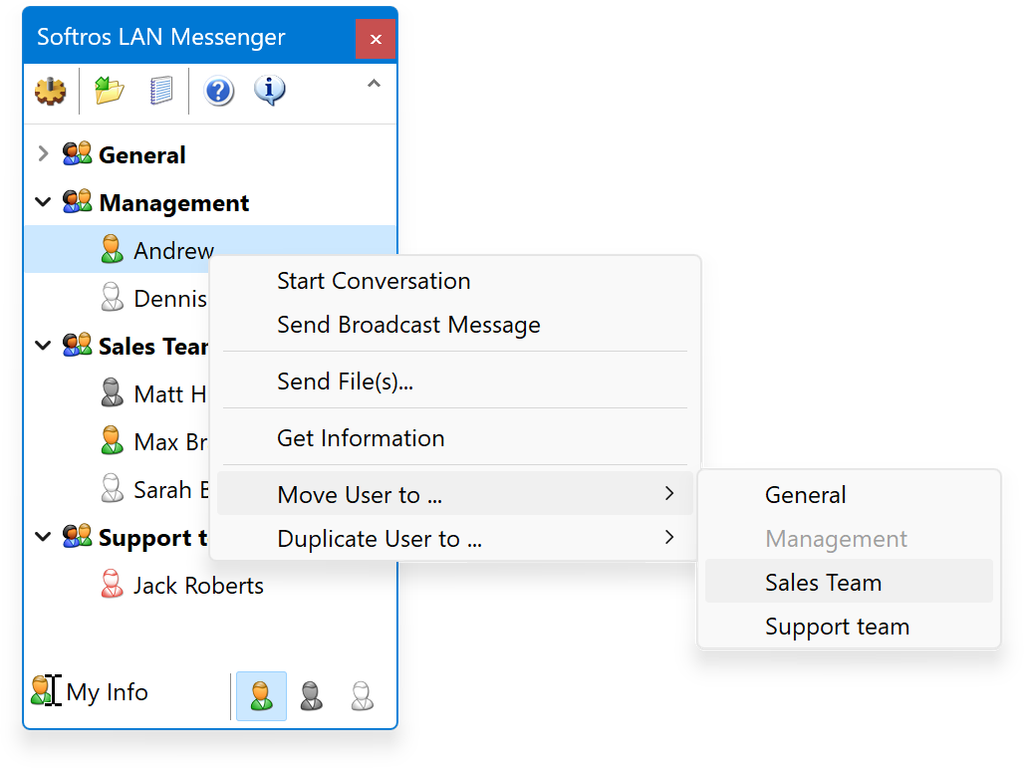
Softros LAN Messenger takes the opposite approach to cloud chat. It is a serverless messenger that runs entirely inside a company’s local network. There is no cloud backend, no central server to maintain and no internet connection required. Computers running the app discover each other automatically and exchange messages directly, peer to peer, with all traffic encrypted using AES-256.
Because Softros does not depend on online services, it cannot be compromised through them. There is no vendor cloud to breach, no web login page to phish and no public endpoint exposed to internet-wide scanning. The attack surface shrinks to the network you already protect with firewalls, endpoint security and access policies. Conversations never pass through third-party infrastructure, so there is no external copy of your data waiting to leak.
The same design delivers resilience. When an internet provider fails or a major cloud platform has an outage, offices running Softros keep talking as if nothing happened. For a clinic in the middle of a busy day or a law firm hours before a filing deadline, that reliability matters as much as confidentiality.
Core Features for Everyday Work
A secure tool is useless if staff refuse to use it, and Softros covers the communication needs of a typical office without a learning curve:
- One-on-one and group chats with a familiar, intuitive interface that needs no training.
- Multi-user video conferencing held strictly within the company network or across connected branches, with no call limits and no third-party video service involved.
- Broadcast messages to notify a whole department or the entire office in seconds.
- Drag-and-drop file and folder transfer to one or many colleagues at once.
- Delivery to offline users: messages are stored and delivered as soon as the recipient comes back online.
- Message history kept locally for reference.
- Quick messages with keyboard shortcuts for phrases staff send dozens of times a day.
- Remote assistance requests, letting a colleague securely connect to help.
- Cross-platform clients for Windows, macOS and Android.
For organizations with their own on-premises software, an SDK and a command-line tool make it possible to send automated messages and files directly from CRM, billing or practice management systems.
A Natural Fit for Dental Clinics, Veterinary Practices and Law Firms
Some businesses can treat chat as a convenience. For others, every message may contain information that must never reach outsiders. Three types of practice stand out.
Dental clinics. Front desks, treatment rooms and imaging stations exchange patient names, treatment plans, X-ray files and insurance details all day. Softros keeps that traffic on the clinic’s own network, which helps practices meet their data protection obligations, such as HIPAA requirements in the United States. A quick message like “Patient ready in room 3” travels to the right chair in a second, without touching the internet.
Veterinary clinics. Reception, exam rooms, the lab and the surgery suite need fast coordination, especially when an emergency comes through the door. A single broadcast alerts the whole team, while lab results and diagnostic images move between workstations with drag-and-drop. Owner contact and payment details stay within the practice instead of a vendor’s cloud.
Law firms. Attorney-client privilege and professional conduct rules require lawyers to take reasonable steps to protect client information. Discussing case strategy, settlement terms or draft filings in a public cloud chat introduces a third party into confidential communication. With Softros, partners and associates can chat and hold video meetings internally, and firms with several offices can link them over a VPN without sending anything through outside servers.
Deployment and Administration
For the IT team, the absence of a server means one less system to patch, back up and monitor. Softros installs on each workstation and works immediately, yet it still offers the controls administrators expect:
- Integration with Active Directory and Entra ID, plus deployment, updates and removal through Group Policy.
- Silent MSI installation for scripted rollouts.
- Administrative restrictions that can disable most features for specific users, from file transfer to changing a display name.
- Export and import of settings for networks without a domain controller.
- Support for multiple subnets, WAN, VPN and VLAN connections, so branch offices can communicate as one network.
- Compatibility with terminal servers.
Small practices with a handful of computers and mid-sized firms with several locations can use the same product without redesigning their infrastructure.
The Bottom Line
Choosing a messaging app for work is ultimately a decision about where your conversations live. Cloud platforms trade control for convenience, and that trade looks less attractive with every new breach headline. For dental clinics, veterinary practices, law firms and any organization bound by client confidentiality, Softros LAN Messenger offers chat, file sharing and video meetings without handing data to a third party or depending on an internet connection.
A 30-day free trial is available at messenger.softros.com, making it easy to test the messenger on your own network before committing.